
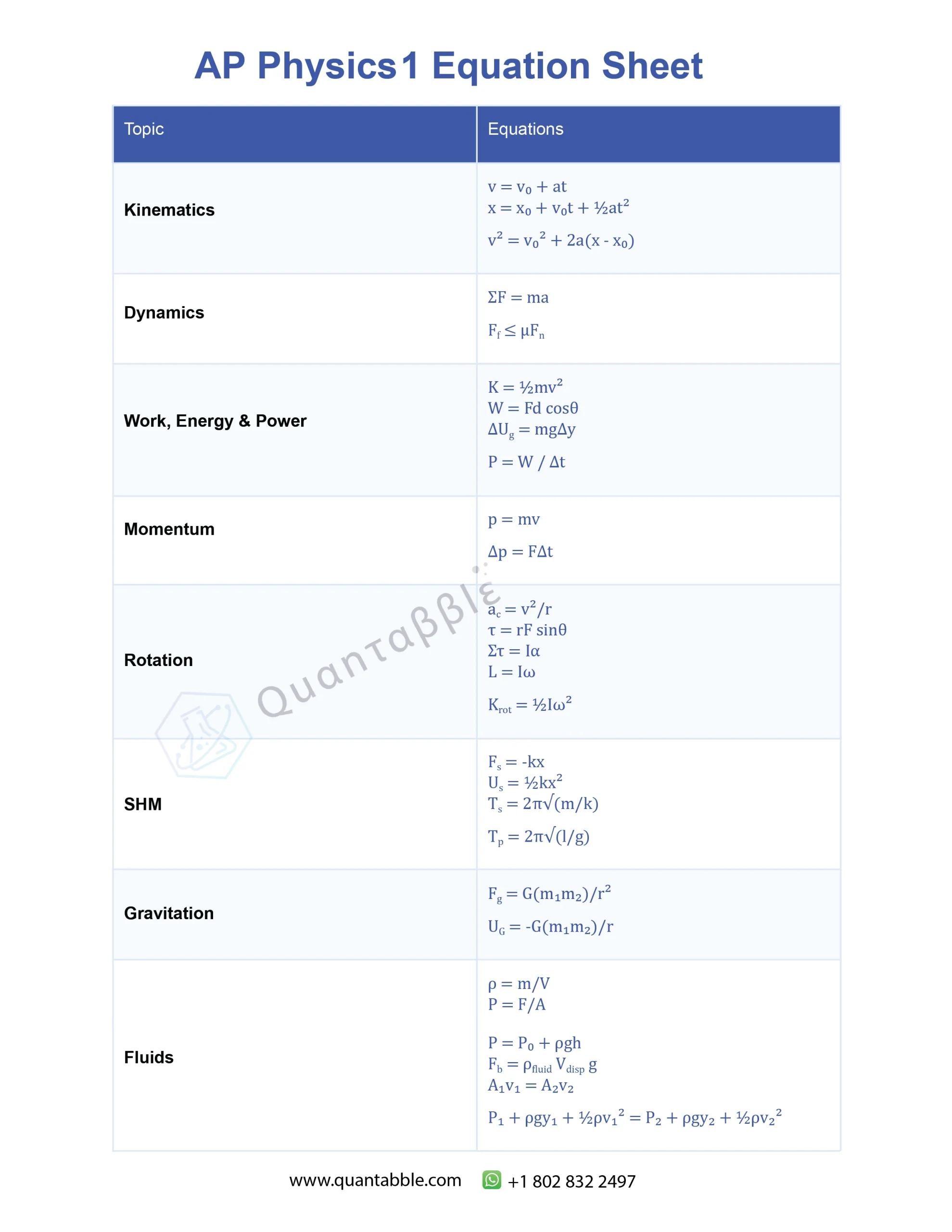
This comprehensive AP Physics 1 equation sheet contains all essential formulas you need for the AP Physics 1 exam. Our annotated formula reference includes detailed explanations, variable definitions, and pro tips for applying each equation effectively.
This physics equation sheet is perfect for exam prep, homework help, and quick reference during practice problems.
📖 Table of Contents
Unit 1: Kinematics
Unit 2: Dynamics
Unit 3: Work, Energy & Power
Unit 4: Momentum & Impulse
Unit 5: Circular Motion & Rotation
Unit 6: Simple Harmonic Motion
Unit 7: Gravitation
Unit 8: Fluids
Complete AP Physics 1 Formula Sheet Guide
This comprehensive AP Physics 1 equation sheet contains all essential formulas you need for the exam. It covers:
- Kinematics equations and motion formulas
- Newton’s laws and dynamics equations
- Work, energy, and power formulas
- Momentum and impulse equations
- Rotational motion and torque formulas
- Simple harmonic motion equations
- Gravitation and fluid mechanics formulas
This formula sheet is ideal for exam preparation, homework help, and quick review.
What Makes This Equation Sheet Different?
Every key equation is paired with practical insights and AP exam strategies.
For example:
- Centripetal force is not a new force; it is the net force directed toward the center.
- The normal force is not always equal to mg.
- Perpendicular forces do zero work.
- A longer collision time reduces average impact force.
This approach helps you move from memorization to true understanding.
How to Use This AP Physics 1 Equation Sheet
You can:
- Download the PDF for offline study.
- Print it and annotate formulas.
- Keep it open while solving practice problems.
- Review it on your phone or tablet.
- Use it for last-minute revision before the exam.
Why AP Physics 1 Students Need a Formula Sheet
AP Physics 1 emphasizes conceptual understanding and algebra-based problem solving. Knowing the formulas is essential, but understanding when and why to apply them is even more important.
A well-organized equation sheet helps you:
- Save time during review.
- Connect related concepts.
- Identify commonly tested relationships.
- Avoid memorization mistakes.